
Search Colleges, Exams, Schools & more


Login
ICMAI CMA New Syllabus Underway, CCM Harshad Deshpande Confirms
The Institute of Cost Accountants of India is expected to release an updated syllabus for all three levels of CMA. Since there was no proper change in the previous 2022 syllabus, this decision was taken after considering the valid feedback of stakeholders. According to CCM Harshad Deshpande, “New syllabus for CMA is in progress.” Though there is no official announcement, it is expected that the ICMAI will soon notify the release of the new CMA syllabus on the website. Now, those students who have registered for the upcoming CMA examinations and are worried about not having enough time to migrate to the new syllabus can relax. As the tweet from CCM Harshad Deshpande further said, candidates will be given enough time to migrate to the new syllabus.
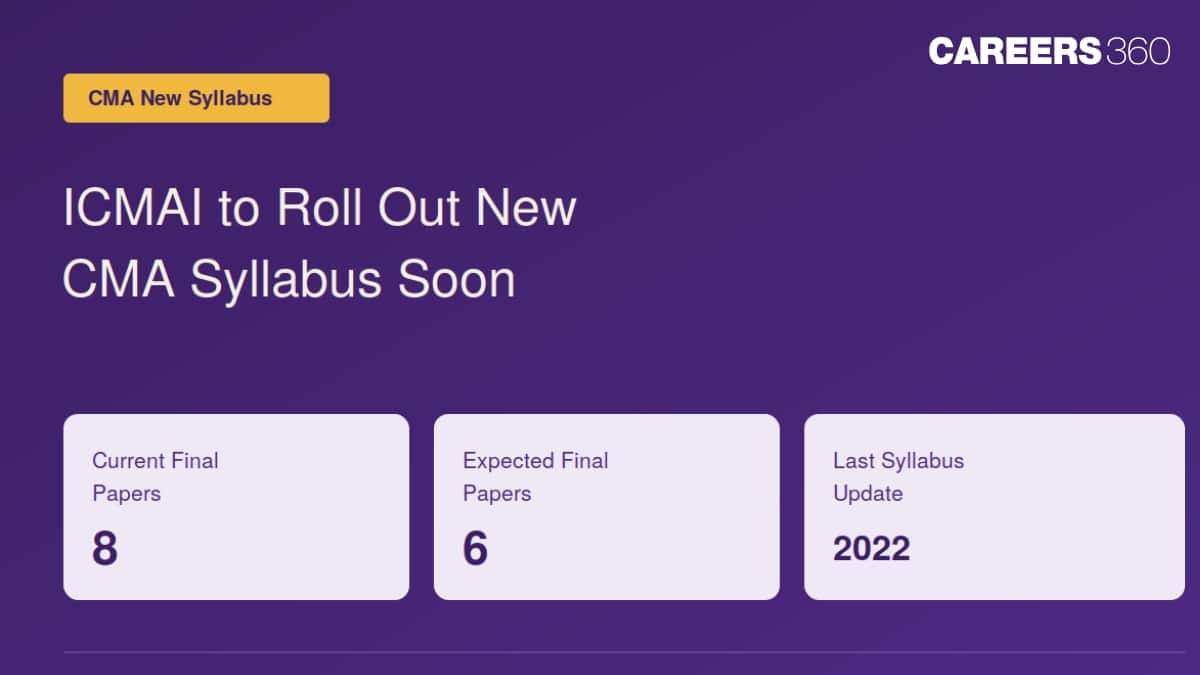
According to unconfirmed reports, it is being circulated that the CMA Final syllabus will have the most changes. The rumours have it that the new CMA Final syllabus will have 6 papers instead of the current 8 papers. Students are advised to rely on verified information and not believe everything they see online.
Expected Changes in the CMA Syllabus
This is a disclaimer that the upcoming changes mentioned below for the CMA syllabus are not official and are just based on unconfirmed reports.
Current Syllabus | Upcoming Syllabus | Core Conceptual Content & Shifts |
2022 Structure (8 Papers) | 2026/2027 Consolidated Draft (6 Papers) | |
Paper 13: Corporate & Economic Laws | Removed from Main Papers / Shifted to Self-Paced | Basic business laws are compressed. Only core Corporate Governance and Insolvency (IBC) are retained for case-study testing. |
Paper 14: Strategic Financial Management | Advanced Financial Management and Valuation | Combines advanced investment decisions, portfolio management, and absorbs Business Valuation from old Paper 20A |
Paper 15: Direct Tax Laws and International Taxation | Direct Tax Laws and International Taxation | Retained with an enhanced focus on corporate tax optimization, DTAA, and BEPS anti-evasion frameworks |
Paper 16: Strategic Cost Management | Paper 3: Strategic Cost Management & Performance Evaluation | Shifts away from mechanical formula drills toward advanced cost analytics, value chain engineering, and data tools |
Paper 17: Cost & Management Audit | Paper 4: Corporate Financial Reporting & Cost Audit | Merges statutory Cost Auditing standards with financial reporting rules to remove compliance evaluation overlap |
Paper 18: Corporate Financial Reporting | See Paper 4 Above | Focused strictly on high-level Ind AS application |
Paper 19: Indirect Tax Laws and Practice | Paper 5: Advanced Indirect Tax Laws and Customs | Upgraded with complete emphasis on GST litigation, dispute resolution, input tax optimization and Foreign Trade policy |
CMA Foundation New Syllabus 2026
Given below is the CMA Foundation chapter-wise weightage syllabus.
Paper No. | Paper Name | Section | Weight |
1. | Fundamentals of Business Laws and Business Communication | Section A: Fundamentals of Business Laws | 80% |
Section B: Business Communication | 20% | ||
2. | Fundamentals of Financial and Cost Accounting | Section A: Fundamentals of Financial Accounting | 70% |
Section B: Fundamentals of Cost Accounting | 30% | ||
3. | Fundamentals of Business Mathematics and Statistics | Section A: Fundamentals of Business Mathematics | 40% |
Section B: Fundamentals of Business Statistics | 60% | ||
4. | Fundamentals of Business Economics and Management | Section A: Fundamentals of Business Economics | 70% |
Section B: Fundamentals of Management | 30% |
CMA Inter Syllabus
CMA Inter Group 1 Subjects |
Paper – 5: Business Law and Ethics (BLE) |
Paper – 6: Financial Accounting (FA) |
Paper – 7: Direct and Indirect Taxation (DITX) |
Paper – 8: Cost Accounting (CA) |
CMA Inter Group 2 Subjects |
Paper – 9: Operations Management & Strategic Management (OMSM) |
Paper – 10: Corporate Accounting and Auditing (CAA) |
Paper – 11: Financial Management and Business Data Analytics (FMDA) |
Paper – 12: Management Accounting (MA) |
CMA Final New Syllabus (2022)
Paper No. | Paper Name | Section | Weight |
13. | Corporate and Economic Laws | Section A: Corporate Laws | 60% |
Section B: Economic Laws and Regulations | 40% | ||
14. | Strategic Financial Management | Section A: Investment Decisions | 25% |
Section B: Security Analysis and Portfolio Management | 35% | ||
Section C: Financial Risk Management | 20% | ||
Section D: International Financial Management | 15% | ||
Section E: Digital Finance | 5% | ||
15. | Direct Tax Laws and International Taxation | Section A: Direct Tax Laws | 60% |
Section B: International Taxation | 40% | ||
16. | Strategic Cost Management | Section A: Strategic Cost Management for Decision Making | 60% |
Section B: Quantitative Techniques in Decision Making | 40% | ||
17. | Cost and Management Audit | Section A: Cost Audit | 50% |
Section B: Management Audit | 25% | ||
Section C: Internal Control, Internal Audit, Operational Audit and Other Related Issues | 15% | ||
Section D: Forensic Audit and Anti-Money Laundering | 10% | ||
18. | Corporate Financial Reporting | Section A: Indian Accounting Standards | 25% |
Section B: Valuation of Shares, Accounting and Reporting of Financial Instruments and NBFCs | 15% | ||
Section C: Accounting for Business Combinations and Restructuring (in Compliance with Ind AS) | 20% | ||
Section D: Consolidated Financial Statements and Separate Financial Statements (in Compliance with Ind AS) | 20% | ||
Section E: Recent Developments in Financial Reporting | 10% | ||
Section F: Government Accounting in India | 10% | ||
19. | Indirect Tax Laws and Practice | Section A: Goods and Services Tax Act and Rules | 70% |
Section B: Customs Act and Rules | 30% | ||
20A | Strategic Performance Management and Business Valuation | Section A: Strategic Performance Management | 50% |
Section B: Business Valuation | 50% | ||
20B | Risk Management in Banking and Insurance | Section A: Risk Management in Banking | 60% |
Section B: Risk Management in Insurance | 40% | ||
20C | Entrepreneurship and Startup | Section A: Entrepreneurial Skill Sets | 15% |
Section B: The Entrepreneurial Eco-system | 15% | ||
Section C: Idea to Action | 15% | ||
Section D: Value Addition | 15% | ||
Section E: Scale up | 10% | ||
Section F: Risk Management Strategies | 10% | ||
Section G: Leadership | 10% | ||
Section H: Types of New Age Business | 10% |
Articles
Related Stories
|
Certifications By Top Providers
Explore Top Universities Across Globe
Popular Courses and Specializations
Questions related to CMA Final
On Question asked by student community
Have a question related to CMA Final ?
Hi,
Yes the final CMA syllabus is expected to change a little for the June 2022 session. The syllabus is updated every 5 years although the changes are not very drastic. As the years go by, some chapters become obsolete and some new chapters need to be include. Thus the

Applications for Admissions are open.
Asia’s only university to be awarded the highest accreditation by WASC, USA and by the Quality Assurance Agency for Higher Education (QAA), UK
SRM University, Chennai Science and Humanities PG 2026
ApplyNAAC A++ Accredited | Ranked #11 by NIRF
Amity University-Noida M.Com Admissions 2026
ApplyAmong top 100 Universities Globally in the Times Higher Education (THE) Interdisciplinary Science Rankings 2026
Chitkara University M.Com Admissions 2026
Apply100% Placements Assistance | 2000+ Campus Recruiters
University of Southampton Delhi Masters Admissions 2026
ApplyApplications fee waiver for all prgrammes | MSc Finance and MSc International Management Admissions 2026 Now Open | Ranked Among the Top 100 Universities in the World by QS World University Rankings 2025
Sharda University Admissions 2026
ApplyAdmission Against Cancellation/Lapsed Seats | Pay 500 Application Fee instead of ₹1500 | NIRF Ranked 87 | NAAC A+ Grade | Upto 100% scholarship
CMA Final Notifications
Never miss CMA Final update
Get timely CMA Final updates directly to your inbox. Stay informed!